
Artificial intelligence is transforming agriculture in ways that don’t make headlines but do change outcomes. Precision AI applies machine learning, computer vision, and predictive analytics directly to farming decisions, from planting and irrigation to harvesting and supply chains.
This is not experimental tech. It’s intelligence applied to land, weather, machinery, and biology, and it’s becoming one of the most practical AI use cases in the global economy.


4
What Is Precision AI in Agriculture?
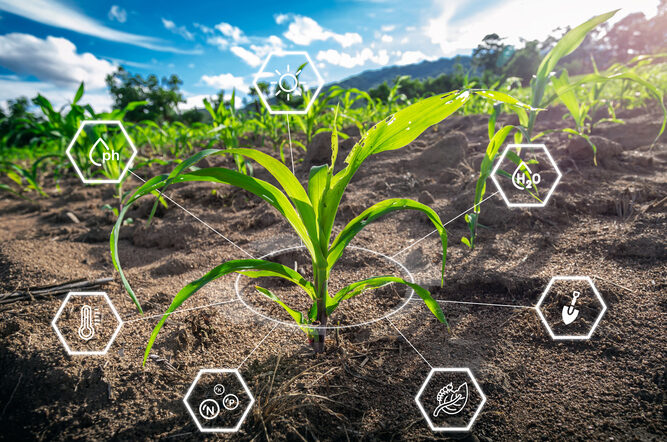
Precision AI refers to AI systems that analyze farm-level data to optimize decisions at a granular level. Instead of treating fields as uniform, AI treats them as millions of variables.
Key inputs include:
- Satellite and drone imagery
- Soil sensors and weather data
- Equipment telemetry
- Historical yield records
The goal is simple: increase output while reducing waste.
Why Agriculture Is a Natural Fit for AI
Agriculture has three characteristics AI handles well:
- Massive data variability
- Thin operating margins
- High cost of mistakes
AI helps farmers decide:
- Where to plant
- When to irrigate
- How much fertilizer to use
- When to harvest
A small efficiency gain scales across thousands of acres. That’s real money.
Core Applications of Precision AI
1. Crop Monitoring and Yield Prediction
Computer vision models analyze images to detect:
- Plant stress
- Disease outbreaks
- Nutrient deficiencies
Early detection prevents losses before they spread.
2. Precision Irrigation and Resource Use
AI optimizes water and fertilizer usage by combining:
- Soil moisture data
- Weather forecasts
- Crop growth models
This reduces costs and environmental impact simultaneously, which regulators and farmers both like.
3. Autonomous and Assisted Machinery
AI enables:
- Self-driving tractors
- Automated harvesting
- Precision spraying
Machinery becomes smarter over time, not just newer.
4. Supply Chain and Pricing Intelligence
AI forecasts demand, optimizes logistics, and reduces spoilage. In agriculture, timing is everything. AI improves timing.
Public Companies Leading Precision AI in Agriculture
Deere & Company (DE)
Deere integrates AI into farm equipment, enabling:
- Autonomous tractors
- Real-time field analytics
- Precision planting and spraying
Why it matters: Deere controls the hardware and the data.
Risk: capital equipment cycles and farm income volatility.
Trimble (TRMB)
Trimble provides positioning, guidance, and data analytics used in precision farming.
Why it matters: software and services scale without rebuilding machines.
Risk: competition and slower adoption in smaller farms.
Corteva (CTVA)
Corteva applies AI to seed genetics, crop protection, and yield optimization.
Why it matters: AI improves biological outcomes, not just operations.
Risk: regulatory and environmental scrutiny.
AGCO (AGCO)
AGCO integrates AI across equipment platforms for precision farming.
Why it matters: strong exposure to smart machinery without overhyping AI.
Risk: cyclical demand and regional exposure.
Precision AI vs Traditional Ag Tech
| Factor | Traditional Ag Tech | Precision AI |
|---|---|---|
| Decision making | Manual / experience-based | Data-driven |
| Resource use | Broad application | Targeted, optimized |
| Scalability | Limited | High |
| Margins | Thin | Improved through efficiency |
Precision AI doesn’t replace farmers. It augments judgment with data.
Risks Investors Should Understand
Precision AI is practical, but not risk-free:
- Adoption varies by farm size and region
- Hardware upgrades are expensive
- Weather remains uncontrollable
- Policy and subsidy changes matter
This is a steady transformation, not a viral adoption curve.
Long-Term Outlook
Precision AI adoption is driven by unavoidable pressures:
- Global food demand
- Climate variability
- Labor shortages
- Cost inflation
AI won’t eliminate these problems. It makes them manageable.
The biggest winners will be companies that:
- Integrate AI into existing farm workflows
- Own both hardware and data
- Monetize software recurring revenue
Final Thoughts
Precision AI is one of the least glamorous but most durable AI investment themes. It doesn’t chase consumers or trends. It improves yields, cuts costs, and stabilizes supply chains.
In a world where everything depends on food, intelligence applied to agriculture isn’t optional. It’s inevitable.
Sometimes the future of AI isn’t in servers or screens.
It’s in fields, quietly compounding.